

Newsletter June 2026
Welcome to our first newsletter! Thank you for being one of the first subscribers to stay up to date with what’s going on at the Belgian Centre for Human-Animal Studies.
We’re excited to share with you we had our first successful networking event at Ghent University. More information can be found below.
In the meantime, feel free to spread the word on BeCHAS and this newsletter to interested colleagues, friends, curious family members and others.
Not subscribed yet? You can do so here!
In this letter
Wrapping up our first networking event SNAIL 2026
What’s new in HAS?
Wrap-up SNAIL 2026
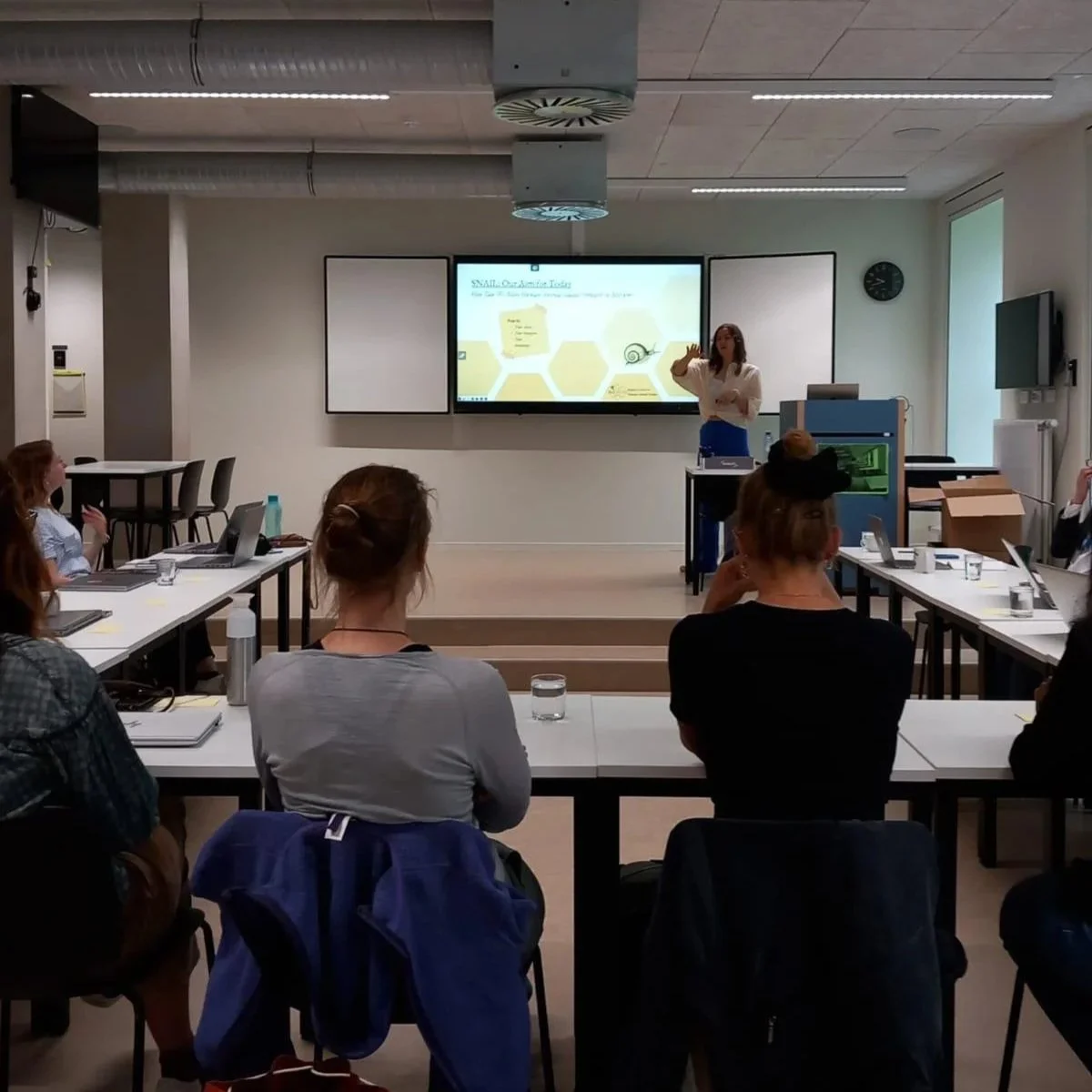
On the 4th of May, we had our first event: SNAIL, The Seminar for Networking on Academic Interspecies Learning. We had a very interesting day with many inspiring conversations with academics from all over Belgium and beyond!
First, we would like to thank prof. dr. Astrid Huopalainen for her interesting presentation on the field animal organisation studies that set the tone for the day!
After this introduction, we had round-table discussions on a wide range of topics and hurdles withing the field of Human-Animal Studies. The take-aways from these round-table discussions can be found below.
Roundtables on animal-centered methodologies:
How to integrate existing and/or create new methods for multispecies research?
Observations and ethnography are good existing methods for multispecies research, however, we need different methods, because translation from other species’ communication is inherently tricky. To understand nonhuman animals better we need to employ epistemic pluralism, this way we decrease the chance of missing out on other things if we only stick to the current Western methodologies.
How to understand animal perspectives?
There are limitations to understanding the animal’s perspective, but understanding is not required for meaningful interaction with others. There is a similar disconnect between humans: we cannot read each others minds and there will always be human bias. This should not be seen as a limitation. Additionally, we should not approach human-animal relations as a bidirectional effect, instead it is a complex, dynamic system. As such we should put each relation in its context as well. This complex systemic perspective can only be understood by involving other disciplines, as well as embracing more creative methodologies.
How to ask for animal consent and ethics?
Asking consent of animals is a contested topic. Some ask consent by waiting for the animals to give a signal that you can commence your research. Others would argue this rests upon the idea that animal behaviours are always authentic, but that they can also be deceptive, which can complicate our interpretation of these signals. Others still would argue that asking consent is not necessary if you do not do an invasive study and that this method should be preferred. Furthermore, getting ethical consent (from a university board) is not necessarily ethical: it is not because they agree, that the experiment is ethical towards animals. This is why we should try to be humble when studying animals and that we as researchers should refrain from falling into the discourse of the object of our study and losing sight of what is important to the animals.

Roundtables on collaboration:
How can we institutionalize Human-Animal Studies?
Institutionalization of HAS comes with extra workload, such as writing annual reports, but it can potentially offer fixed positions within academia. The question remains if this intitutionalisation should happen as one local group, based in a fixed location or if there are more benefits to organising in a more fragmented way where each university has some HAS researchers. Additionally, financial support can come from universities, FWO, as well as from private companies.
How can we legitimize Human-Animal Studies?
Collaboration across disciplines means finding the right people within other disciplines to collaborate with who also support the field of Human-Animal Studies. HAS-research is inherently value-loaded, though for legitimization of the field we need to also be pragmatic without necessarily compromising on values to make the research more visible. However, identity politics is also prevalent in the field, where researchers become or are openly activist in their research. The research question typically reveals the subjective nature of the research and therefore the goal of the study. However, as a researcher, we should focus on small changes/sparks to stay motivated and not get drained when big changes don’t happen. The most crucial part of our research is the dissemination of knowledge to the public.
How can we live and collaborate with nonhuman animals beyond academia?
We need to be reflective of ourselves, our approaches in research, our assumptions and biases, as well as being open in our encounters with the world around us and listen to nonhuman animals’ voices. We need to be patient regarding change: perspectives are shifting, slowly but surely. As academics, we must build our own voice to communicate our research so that the societal debate on the nonhuman animal extends beyond ideological aspects. Finally, as HAS-scholars, we should acknowledge other beings around us in our lives, both professional and personal lives.
As you can tell, we had lots of interesting conversations with many different insightful perspectives on many possible avenues for futher research and discussions. As ever, we wrapped up with more questions than answers.
We look forward to inviting you for our next events. Stay tuned!
What’s new in HAS?
Publishing in Critical Animal Studies with prof. dr. Nik Taylor and dr. Zoei Sutton.
Animals in Society online course at Mälardalen University by prof. dr. David Redmalm.
Starting in autumn 2026. Information on application, see this facebook page.
The deadline for application is the 12th of June(!).
The Nordic–Baltic Symposium on Animal Studies: Present Challenges and Future Endeavours.
Organised at Lunds Universitet on the 16th of October. Application possible until 18th of September.
Got news?
Have anything to share with us/with the community? Please let us know via info@bechas.be!